
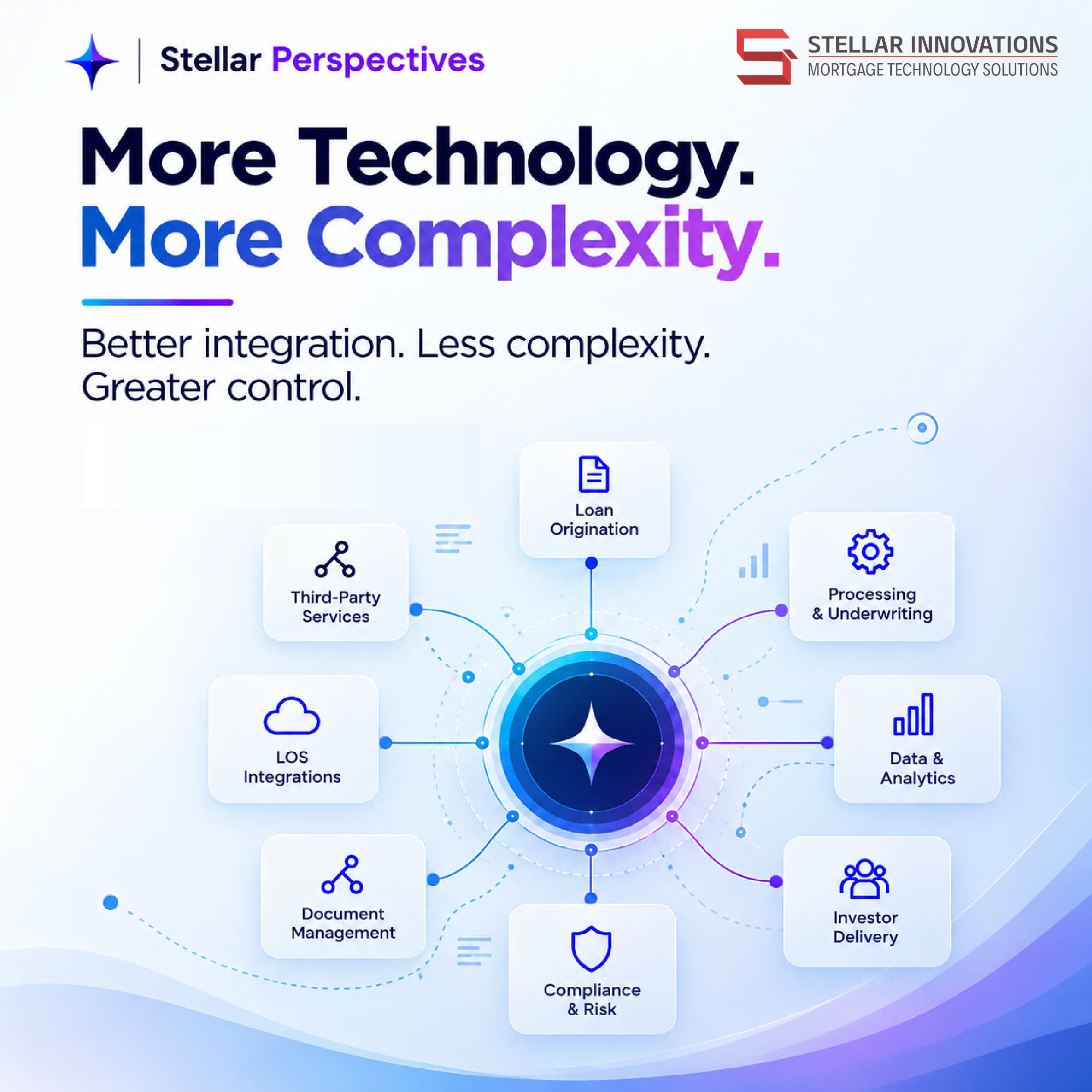
Following last week’s MBA Annual Conference in Chicago, the Stellar Innovations team met with leaders from across the industry. The message was clear: With lower projected loan volumes, the need to operate efficiently and do more with less has never been greater.
The mortgage industry has spent more than a decade investing in the digital mortgage experience. Lenders have adopted new point-of-sale platforms, automation tools, data services, workflow enhancements, and borrower-facing technologies with the goal of creating a faster, more efficient process.
But the economic equation behind those investments continues to become more challenging.
The Mortgage Bankers Association’s newly revised forecast calls for total single-family mortgage originations to decline 5% in 2027 to just under $2 trillion, down from the $2.1 trillion expected in 2026. Purchase originations are projected to increase only 0.8% to $1.42 trillion, while refinance volume is expected to fall 17% to $571 billion. MBA also expects total loan count to decline by 5.6%, from approximately 5.3 million loans in 2026 to 5.0 million in 2027.
Those numbers matter because lenders are not simply facing another year of margin pressure. They are being asked to support increasingly sophisticated technology and vendor ecosystems across fewer transactions.
The interest-rate outlook compounds the challenge. MBA expects the 30-year mortgage rate to average 7.3% in the fourth quarter of 2026 and remain above 7% throughout 2027, with the 10-year Treasury remaining near 5%.
In that environment, efficiency cannot simply mean adding another tool.
Production costs remain under pressure. Margins remain tight. Compliance expectations continue to expand. At the same time, lenders are expected to deliver a smoother borrower experience while managing an increasingly complex network of vendors, integrations, service providers, and internal systems.
That complexity is becoming one of the industry’s most overlooked operational challenges.
Every new tool or vendor may solve a specific problem, but it can also introduce another connection to maintain, another workflow for teams to learn, another contract to manage, another invoice to reconcile, and another point of failure when something does not work as expected. Over time, the technology stack can become less like a coordinated system and more like a collection of useful but disconnected parts.
This is not a technology failure. In many cases, the tools themselves are strong. The problem is the operating model surrounding them.
Lenders are often left to manage the connective tissue themselves. Vendor selection, ordering, fulfillment, reconciliation, and oversight can sit across multiple systems and departments. That creates friction for operations teams, reduces visibility for leadership, and becomes increasingly difficult to justify when the industry is competing for a smaller number of transactions.
As more artificial intelligence, automation, and specialized service providers enter the mortgage ecosystem, this challenge will become even more important. The question for lenders is no longer simply, “Which tool should we add?” It is also: “How does this fit into our operating model, and does it actually lower the cost and complexity of manufacturing a loan?”
That distinction matters in a market MBA now projects only about 5 million loans in 2027.
The next phase of mortgage technology may therefore be less about adding more point solutions and more about making the overall ecosystem easier to manage. That means simplifying access, improving vendor optionality, centralizing activity where possible, and giving lenders a clearer view of how third-party services support each loan file.
For lenders, the opportunity is not just efficiency. It is control.
A more connected ecosystem can help reduce operational drag, strengthen oversight, improve adoption, and allow teams to spend less time managing disconnected processes and more time moving loans forward.
The industry has made meaningful progress on the digital mortgage journey. But MBA’s revised 2027 forecast underscores a harder reality: lenders may have to compete for fewer loans in a higher-rate environment while continuing to carry the technology, vendor, and compliance infrastructure built around their businesses.
The next competitive advantage may not come from adding another technology provider. It may come from making the technology, vendors, and workflows lenders already depend on work together as one operating ecosystem.
To learn how Stellar Innovations helps lenders simplify vendor management, connect workflows, and improve operational efficiency contact Steven Greenfield, CMB®, at Steven.Greenfield@stellaripl.com.