
Repurchase Risk Is Evolving: What Lenders Should Focus on in 2026
For many lenders, repurchase demands may feel like a challenge of the past. However, recent data from Fannie Mae and Freddie Mac tells a different story. While overall loan quality has improved and many lenders have strengthened their underwriting and quality control processes, repurchase risk remains active across recent loan vintages.
What’s changing is where that risk is emerging.
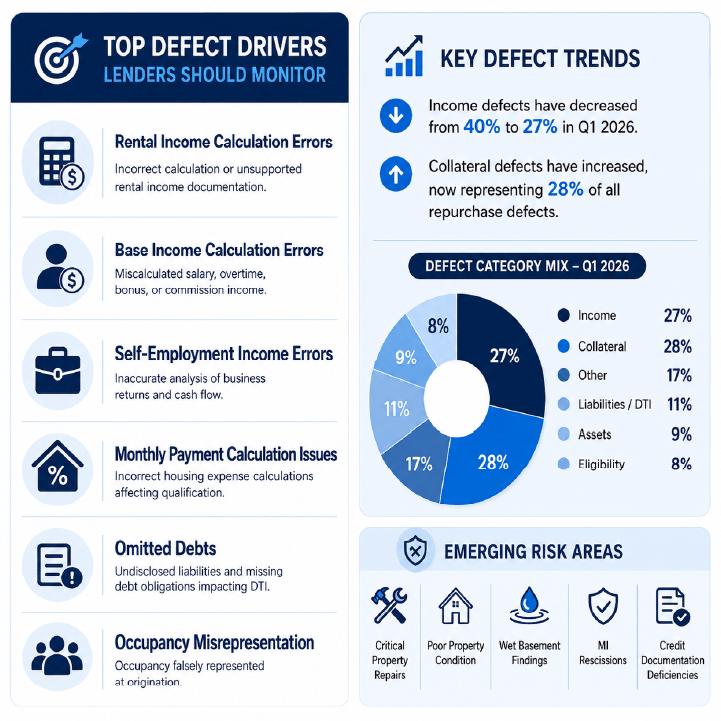
The latest Freddie Mac repurchase trend reporting shows that income-related defects have declined from 40% of repurchase findings in 2025 to 27% in Q1 2026, suggesting that investments in income validation tools, automation, and quality review processes are beginning to deliver measurable results. At the same time, collateral-related defects have increased to 28% of all repurchase findings, making collateral quality the largest defect category in the most recent reporting period.
For lenders operating in an environment of compressed margins, evolving regulations, and increasing investor expectations, these findings highlight an important reality: repurchase risk has not disappeared—it is evolving.
The Shift from Income Risk to Collateral Risk
For years, income calculation errors have been one of the leading drivers of repurchase activity. Borrowers with self-employment income, variable compensation, rental income, and multiple income streams often introduced complexity that created opportunities for calculation errors and documentation gaps.
Recent Freddie Mac reporting suggests progress in this area. Income-related defects have steadily declined throughout 2025 and into 2026, reflecting the industry’s growing adoption of automated income analysis, standardized calculation methodologies, and enhanced quality control practices.
However, as lenders improve income validation, another challenge is becoming more prominent.
Collateral-related defects, including critical repairs, property condition concerns, appraisal issues, and valuation-related deficiencies, have increased significantly and now represent the largest share of repurchase findings. Freddie Mac specifically highlights issues such as critical repairs, poor property conditions, and wet basement findings as key contributors to collateral defects.
The message is clear: lenders cannot focus solely on borrower qualification. Loan quality depends equally on the integrity of the collateral supporting the transaction.
Four Areas Lenders Should Prioritize in 2026
- Strengthen Collateral Review Processes
With collateral defects now representing the largest repurchase category, lenders should increase focus on appraisal quality, property condition reviews, valuation consistency, and collateral documentation completeness.
Enhanced appraisal review workflows and technology-enabled collateral validation can help identify issues earlier in the loan lifecycle.
- Maintain Momentum in Income Validation
Although income defects have declined, they still account for more than one-quarter of repurchase findings. Lenders should continue investing in standardized income calculations, automated verification solutions, and secondary reviews for complex borrower profiles.
The progress achieved should not result in reduced vigilance.
- Improve Documentation Integrity
Many repurchase findings ultimately stem from missing, incomplete, or unsupported documentation.
Whether related to income, liabilities, collateral, or eligibility requirements, strong documentation controls remain one of the most effective ways to reduce operational risk and improve audit readiness.
- Align Quality Control Programs with Emerging Defect Trends
Quality control programs should evolve alongside repurchase trends.
Rather than relying solely on historical defect patterns, lenders should continuously monitor GSE reporting and adjust review priorities to focus on the categories generating the highest levels of repurchase activity.
Moving from Detection to Prevention
Historically, quality control has been viewed as a post-closing activity designed to identify defects after loans have already been originated.
Today’s lending environment requires a different approach.
Technology, automation, and advanced quality control solutions enable lenders to identify risks earlier in the manufacturing process, allowing corrective action before loans are delivered to investors.
Organizations that shift quality management upstream can reduce defects, improve operational efficiency, strengthen investor confidence, and lower repurchase exposure.
The Path Forward
The latest GSE reporting reinforces a simple but important message: repurchase risk remains active, but the drivers of that risk continue to evolve.
While income-related defects are declining, collateral quality has emerged as a growing area of focus. Documentation integrity, borrower qualification accuracy, and proactive quality control remain critical components of a strong risk management framework.
For lenders navigating 2026 and beyond, the goal is not simply to respond to repurchase demands—it is to build processes that prevent them.
Organizations that invest in proactive quality control, operational consistency, collateral oversight, and technology-enabled validation will be best positioned to reduce risk, improve loan quality, and protect profitability in an increasingly competitive market.
At Stellar Innovations, we help lenders strengthen loan quality through technology-enabled quality control, operational expertise, and mortgage solutions designed to identify risk before it becomes a costly issue.